Escape the city, pitch a tent, and light up the night. That’s the camping dream. But a good camping trip isn’t just about showing up with a tent. If you plan to stay out for a week in the wild — cooking your own meals, staying warm through cold nights, and avoiding upset stomachs from undercooked food — you need the right gear.
And one piece of gear that can make or break your trip? Your camping stove.
Tents, sleeping bags, and stoves are the big three of any outdoor setup. In this guide, we’re going deep on stoves: the different types, what each is good at, where each falls short, and what I’ve learned from years of using them in the field.
Why a Good Stove Matters More Than You Think
A camping stove does two critical jobs: cooking food and heating your shelter.
If your stove can’t bring water to a rolling boil, you’re risking foodborne illness. And in spring, autumn, or winter, nights get cold fast. Open fires aren’t allowed in many campsites, and burning wood, alcohol, or other carbon-based fuels in an enclosed space produces carbon monoxide — which is odorless, colorless, and deadly.
That’s why picking the right stove, and using it safely, is non-negotiable.
There are four main categories of camping stoves: wood stoves, kerosene stoves, alcohol stoves, and gas stoves (with four sub-types).
For beginners, here’s the short version of what to buy:
Gas stoves > Liquid fuel stoves > Everything else (wood, alcohol, kerosene)
Within gas stoves, my personal recommendation: split type > cassette > all-in-one > integrated.
1. Wood Stoves — The Cozy, Old-School Choice
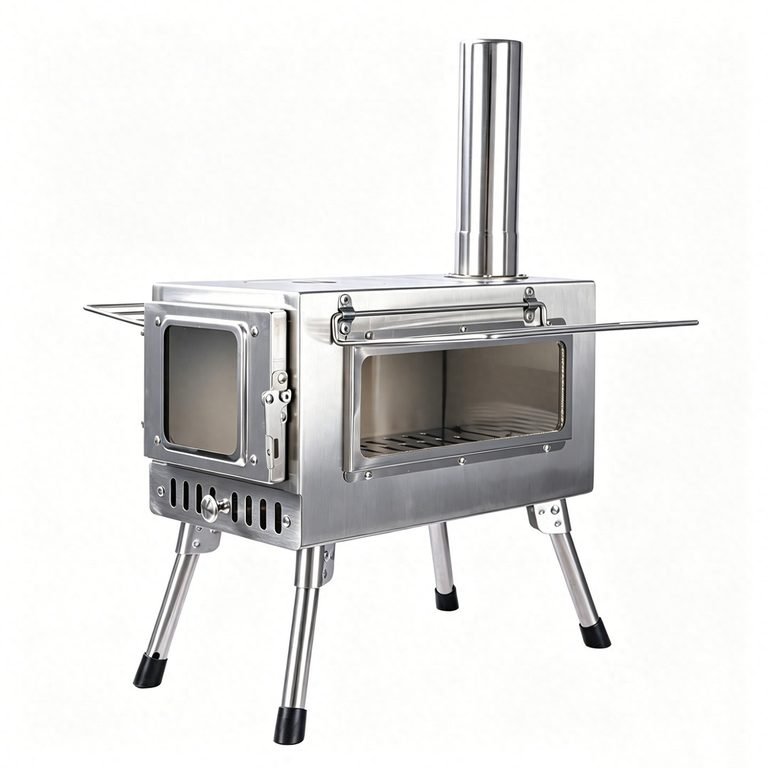
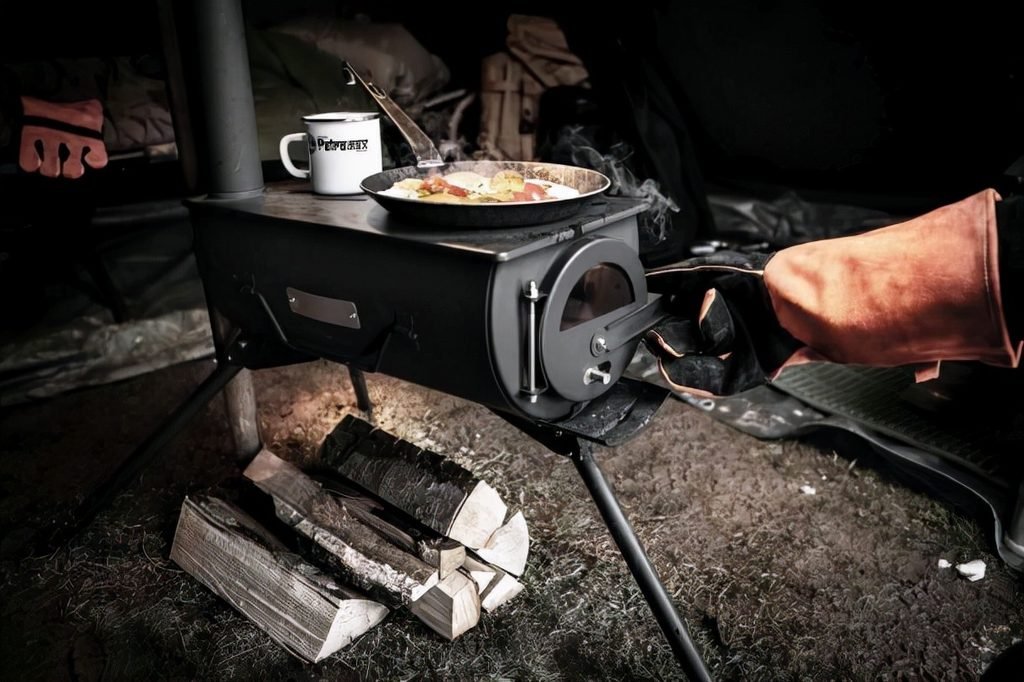
Wood stoves are the most primitive, the most atmospheric, and honestly, the most romantic way to cook outdoors. Out in the wild, you can almost always find dry branches and fallen wood, so fuel is essentially free. Experienced campers even build a stone fire pit from scratch and cook over it — it feels like cooking in a medieval army camp.
Wood stoves burn either firewood or solid fuel pellets.
Pros
- Heats and cooks — you can boil water, fry food, and warm your tent
- Fuel is free — gather dead wood anywhere
- Great wind resistance and stability — heavy steel body holds up in gusts
Cons
- Heavy and bulky — most models need a collapsible chimney pipe, so they’re car-camping only
- Won’t work in rain or snow — wet wood won’t burn
- High carbon monoxide risk — incomplete combustion is common, so indoor use needs serious ventilation
Premium imported wood stoves are beautifully made with 304 stainless steel and come with chimney kits that extend through your tent roof. They cut down on CO buildup compared to open burning, but they’re expensive — often well over $500 — and weigh 20+ pounds.

Chinese domestic 304 stainless steel stoves offer a similar experience for a fraction of the price, usually around \(50–\)100. Korean brands are also available but don’t match domestic quality for the price.

What to Look For
- A stove with an installable, extendable chimney — so you can vent it through the tent roof
- Good wind resistance and structural stability — safety first in gusty conditions
- Weight under 22 lbs (10 kg) — anything heavier gets old fast
- A glass viewing window so you can monitor the fire
- Compatible with firewood, wood blocks, or pellets
- A built-in automatic blower fan saves you from manual stoking
Best for: Car camping, base camp, and anyone who values the cozy campfire vibe over backpacking light.
2. White Gas (Liquid Fuel) Stoves — The High-Altitude Workhorse
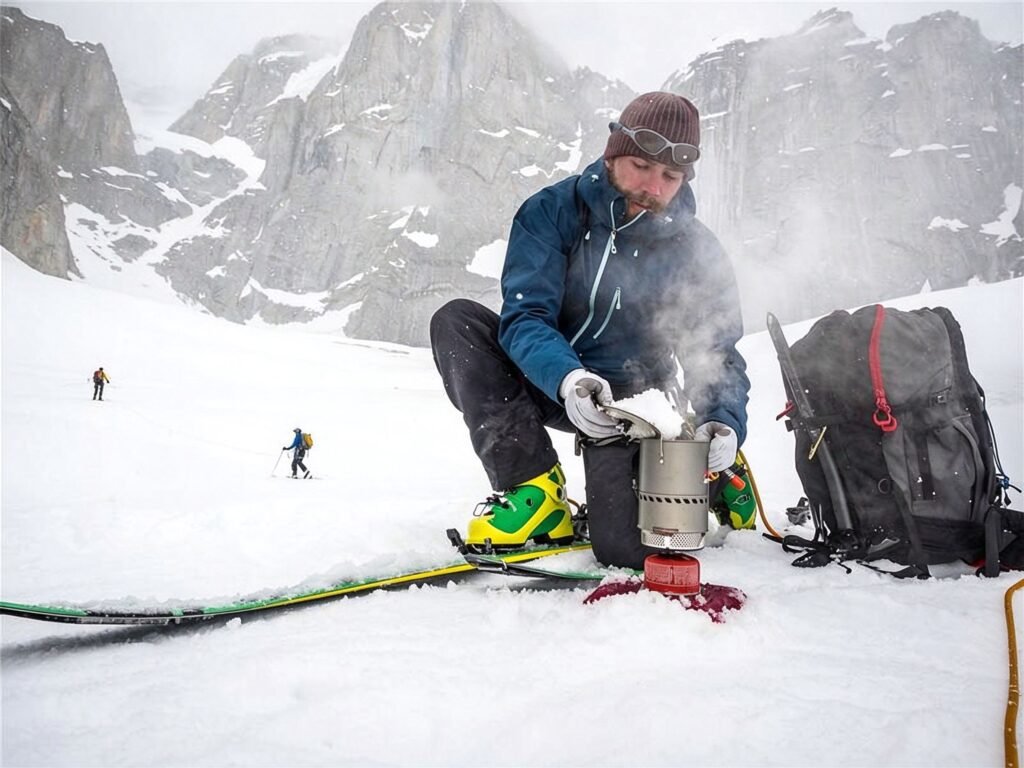
“Liquid fuel” in the camping world almost always means white gas — a highly refined, extremely volatile fuel that’s the gold standard for mountain and expedition stoves in North America. It burns hotter than butane canisters, melts snow fast, and boils water quickly even in subzero temperatures.
White gas stoves can self-pressurize (unlike kerosene stoves), but you must use the right fuel. Never put regular unleaded gasoline, kerosene, or diesel into a white gas stove — you’ll clog the jet, cause dangerous pressure buildup, or produce toxic fumes.
Liquid fuel stoves come in all-in-one (burner and fuel tank fused) and split type (burner connected to a fuel bottle via a hose).
Pros
- Light for long-distance travel — fuel bottles are compact
- Easy to source fuel — gasoline, kerosene, diesel all work in a pinch (with the right stove)
- Very high heat output — melts snow, boils fast
Cons
- Annoying to use — you have to pre-pressurize the tank before lighting
- Needs regular maintenance — the jet clogs easily; after just 3–4 uses, you may need to clean it
- Not beginner-friendly
Best For
Experienced campers, backpackers, and anyone heading to high altitudes or remote regions where canister fuel isn’t available. Brands like MSR are the classic choice here.
Price range: Domestic models start around \(50; imported expedition-grade stoves run \)200+.
3. Kerosene Stoves — The Tent Heater That Actually Works
Kerosene is much less volatile than white gas, which makes it easier and safer to store and carry. It also has a very high heat output — it’s the same fuel used in small aircraft.
In China, kerosene can be hard to find at regular gas stations. Some products marketed as “special kerosene stove fuel” are just regular kerosene repackaged, and it’s not cheap — expect to pay \(1–\)1.50 per liter. Running a heater all night at home would get expensive fast.

Types of Kerosene Stoves
Most kerosene stoves on the market are Japanese-made. They come in three main designs: basic convection type, reflector type (adds a heat reflector), and blower type (battery or plug-in fan). Domestic Chinese models are almost all basic convection type and cost around \(50–\)100. Japanese imported models run \(300–\)600.
What to Look For
If you’re buying a kerosene stove specifically for tent heating (rather than just cooking outside), the key question is fuel smell. Light the stove and let it run for 10 minutes — if you can still smell kerosene, don’t buy it. You’ll never be able to sleep in a tent that reeks of fuel.
Pros
- No chimney needed — safe to use inside a tent (with ventilation)
- Cleaner burn than wood — produces less CO than an open wood fire
- Built-in safety features — Japanese models have automatic flame-out sensors that trigger on earthquake, impact, tipping, or sudden drafts. These are purely mechanical and don’t need batteries.

Cons
- Strong fuel smell on ignition and extinguishing — fades as it reaches operating temperature
- The wick wears out — kerosene stoves burn via a fabric wick, which needs replacing periodically
- Fuel consumption: about 0.25–0.3 liters per hour
Safety note: Korean-made kerosene stoves are available cheaply, but in my testing, the fuel smell indoors was still strong even after extended burning. I’d skip them — the price savings aren’t worth the headache.
Japanese Kerosene Stoves: The CO Warning
There are four major Japanese kerosene stove brands. Japanese stoves have thoughtful details — many come with built-in CO alarms. But here’s what most people don’t realize: Japanese CO alarms are calibrated for indoor home use, where CO levels rise slowly. I tested one that triggered at 200 PPM — and it takes about 30 minutes to climb from 50 PPM to 200 PPM in a tent. In a closed sleeping space, that slow rise is dangerous. Don’t assume your stove’s built-in alarm is enough for tent camping.
4. Alcohol Stoves — The Ultralight Minimalist’s Choice
Alcohol stoves are tiny, light, and best suited to gentle cooking: boiling water, simmering porridge, frying an egg over low heat. Serious campers rarely choose an alcohol stove as their primary cook system, but they’re cheap, light, and make a great backup.

Buying Tips
- Use thin-walled, high-conductivity pots — they transfer heat best
- Use solid alcohol blocks rather than liquid alcohol. If liquid alcohol spills, the resulting flare is nearly impossible to put out.
- Choose a stackable, compact model that packs down small
Pros
- Extremely light and portable
- Very cheap — no need for expensive imported models; domestic ones are fine
- No canister needed — great where gas canisters aren’t allowed or available
Cons
- Low heat output — the slowest option for boiling water
- Poor wind resistance — needs a windshield
- Only works at low altitudes — alcohol boils at a lower effective temperature in thin mountain air
- Not for heating — cooking only
If you only go out on short trips, don’t want to spend much, or need a backup stove, an alcohol stove is a cheap and cheerful option.
5. Gas Stoves — The Most Popular Choice
Gas stoves are the most widely used camping stoves today. They come in four sub-types: all-in-one, integrated canister, split type, and cassette.
Split-Type Gas Stoves
A split-type stove has the burner head separate from the fuel canister, connected by a flexible hose. This is the classic “big camp stove” you’ve probably seen at group campsites.

Pros:
- Compact burner + large canister capacity
- High heat output and strong boil time
- The hose means the canister sits on the ground, away from the heat — much safer
- Very stable and sturdy — supports large pots for group cooking
Cons:
- Bulkier and heavier than all-in-one models
- The connection between hose and canister must be airtight — always test it
- Set up on flat ground; a wobbly connection causes the flame to flicker unpredictably, which is dangerous
All-in-One Gas Stoves
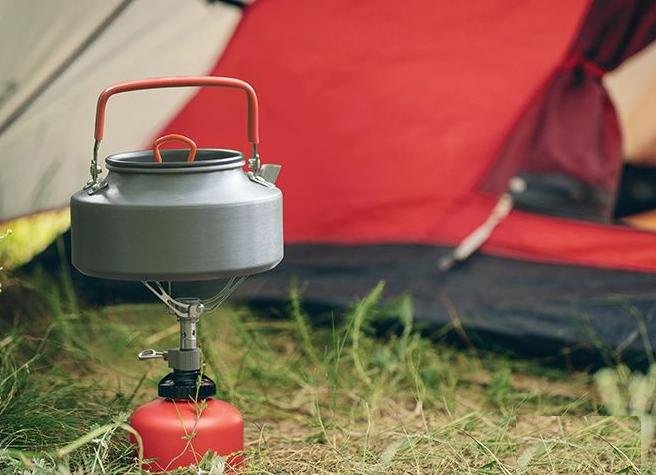
The burner screws directly onto the top of the canister — no hose, no separate parts. Most weigh between 60–200 grams and fit in the palm of your hand.
Pros:
- Very light and compact
- Simple, fast setup
- Great for solo or duo trips
Cons:
- Less stable — the whole setup wobbles on top of the canister
- Poor wind resistance
- Small burner means small pots only
- Because the burner sits directly on the canister, heat can transfer down — be careful
Many campers keep an all-in-one as a backup stove even when their main cook system is a split type.
Integrated Canister Stoves (High-Altitude Stoves)
These are specialized stoves designed for alpine and cold-weather use. The whole point is: boil water fast in freezing, high-altitude conditions. They’re highly efficient and wind-resistant, but they’re single-purpose — you can’t really fry or sauté on them.
Pros: Unbeatable at high altitude, excellent wind resistance, very high thermal efficiency.
Cons: Heavier than all-in-one, more complex to clean, boiling water only. Don’t buy this unless you’re actually going to the mountains.
Cassette Stoves (Butane Tabletop Stoves)
Cassette stoves are the familiar tabletop butane stoves you’ve seen at Korean BBQ restaurants. They’re big, sturdy, and great for car camping — a full hot pot meal is no problem.
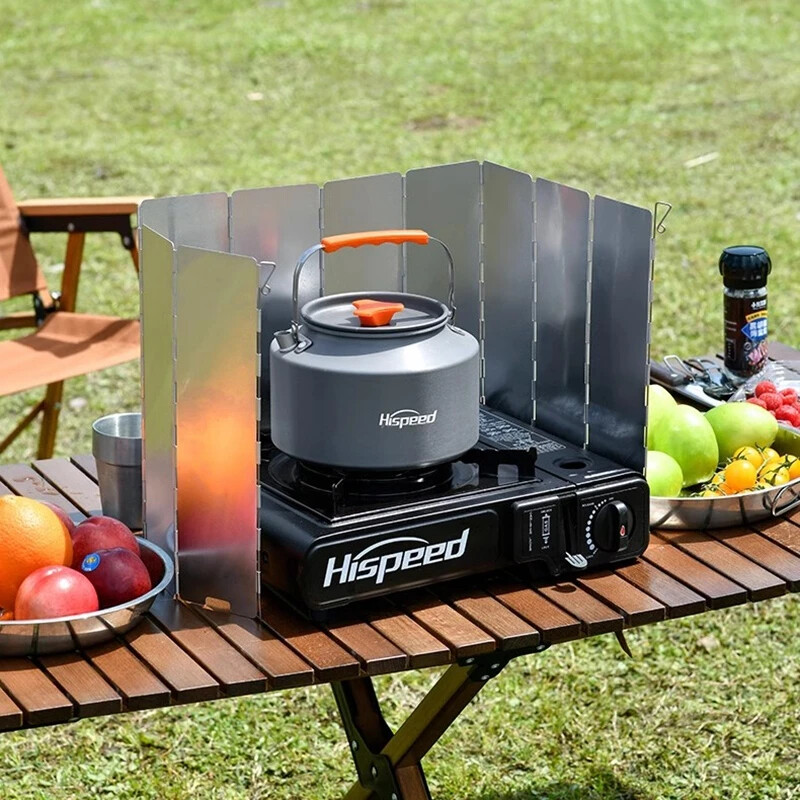
Most people already own one of these at home. Why did hot pot restaurants switch to induction cooktops? Because cassette stoves have a known safety risk. Inside every cassette stove is a pressure-regulating valve with a spring. That spring wears out over time with repeated use. When it fails, the canister can overpressurize.
Buy a reputable brand. Don’t cheap out on a no-name cassette stove — the safety risk is real. And be aware that some campgrounds and fire bans prohibit cassette stoves.
The Two Safety Risks That Actually Matter
Every camp stove burns carbon-based fuel — alcohol, liquid fuel, wood, or gas. When oxygen runs low, you get carbon monoxide (CO). Wood stoves are the worst offenders, but all of them produce CO if you use them in an enclosed space.
Carbon Monoxide Poisoning
CO is colorless and odorless — you can’t smell it, and by the time you feel symptoms, it may already be too late.
I read about a case where a woman used a charcoal heater in a closed room and got mild CO poisoning — just a little dizziness and nausea. She ignored it. Two weeks later, she suddenly lost bowel control, couldn’t speak, and had trouble moving. She was diagnosed with delayed-onset CO encephalopathy.
This is the scary part: CO poisoning has a 2–60 day “lucid interval”. You feel fine, you think you’ve recovered, and then — bang — neurological symptoms hit. It can be fatal.
If someone gets CO poisoning outdoors and seems to recover, do not assume they’re fine. Get them to a hospital immediately.
Which CO Alarm Should You Buy?
Cheap commercial CO alarms (the kind found in restaurant kitchens) are calibrated to trigger at 150 PPM. They use a liquid electrochemical sensor that oxidizes in open air, so their accuracy degrades quickly. They’re designed for controlled indoor environments, not for a cold, ventilated tent.
For camping, look for a solid-state electrochemical sensor CO alarm that reads in real time. It costs more, but it’s the difference between an early warning and a surprise.
Carbon Dioxide Buildup (CO₂)
CO₂ isn’t as immediately toxic as CO, but it builds up fast in a sealed tent when you’re breathing all night — even without a stove running. Add a heater burning inside, and it climbs even faster.
Symptoms start with headaches, poor focus, and grogginess — easy to mistake for just “a bad night’s sleep.” At higher concentrations, it can be life-threatening.
The simplest defense? Ventilation. Crack a window or vent every night, even in cold weather. If you can swing it, a CO₂ monitor is a cheap insurance policy.
Final Thoughts
There’s no single “best” camping stove — the right one depends on where you’re going, how many people you’re feeding, and what you’re carrying.
Quick recap:
- Car camping, group trips, winter warmth → Wood stove or kerosene stove
- High altitude, expedition, remote trails → White gas stove or integrated canister gas stove
- Car camping, casual cooking, hot pot nights → Cassette stove or split-type gas stove
- Backpacking, ultralight, solo trips → All-in-one gas stove or alcohol stove
Whatever you choose, always prioritize ventilation and CO safety. A great camping trip is the one you come home from feeling great — not the one you end up telling the ER doctor about.
Happy camping. Stay warm, and stay safe.