Ask any hiker what the hardest part of a long trek is, and many will surprise you with the answer: figuring out what to eat. Even seasoned backpackers — the ones who have walked across thousands of miles of mountains and valleys — often struggle with trail food. They either feel hungry all the time, or they pack too much and carry dead weight.
Here’s the thing: trail food is deeply personal. How much you need depends on your body weight, the temperature where you’re hiking, how heavy your pack is, and what you actually enjoy eating. There is no one-size-fits-all menu. But there are solid principles — and real numbers — that can help you pack smartly for any trip.
Let’s look at a concrete example first. For a week of hiking in normal (non-extreme) conditions, 0.6 kg of dehydrated food per day is enough to give you 2,000–2,400 calories. That won’t fully cover your energy deficit, but your body fat will help make up the difference. If your trip stretches past a week, bump it up to 800 g per day (about 2,800–3,200 calories) starting around day seven — otherwise the hunger hits hard. Go beyond three weeks, and you’re looking at 1 kg per day, roughly 4,000 calories. And for people climbing Everest? Even 2 kg a day isn’t too much.
Food, in other words, is one of the most important decisions you’ll make before you hit the trail.
Part 1: How Much Energy Does Your Body Burn on the Trail?
Your daily energy budget
Your body burns energy through two main channels: your basal metabolism (the energy you need just to stay alive) plus physical activity. A simple rule of thumb for your daily baseline is:
body weight (kg) × 30 = basal calories per day
For most people that works out to roughly 2,000–2,400 calories per day for men and 1,500–2,000 calories per day for women.
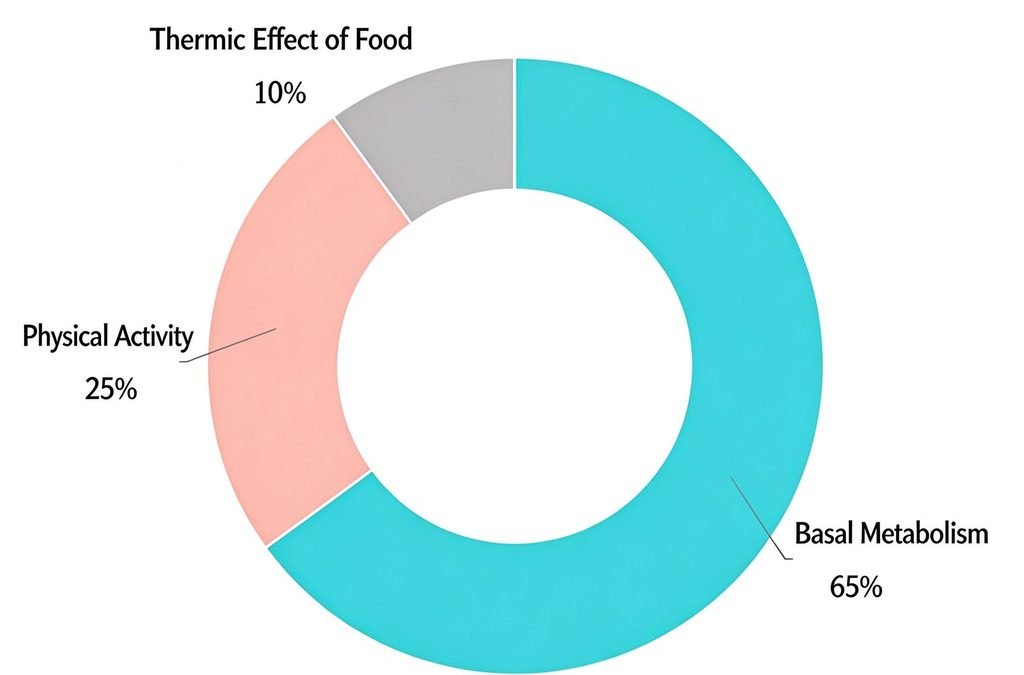
Here’s how that energy is split on an average day:
- Basal metabolism – 65%: the energy your body burns just to keep your heart beating, lungs working, and cells repairing.
- Physical activity – 25%: everything from walking to carrying your pack.
- Thermic effect of food – 10%: the energy used to digest and process what you eat.
To estimate your exercise burn more precisely, hikers use METs (metabolic equivalents). The formula is simple:
MET coefficient × (body weight + pack weight) = calories burned per hour
One important limit to remember: the human body can realistically burn about 4,000 calories per day — roughly double the basal rate. Push past that, and you’ll feel exhausted, and your recovery will slow dramatically.
How much can you actually cover in a day?
Strip out rest time, and a fit hiker can manage roughly:
- 6–7 hours of flat-terrain hiking per day
- 4–5 hours of low-altitude mountain hiking
- 2–3 hours of high-altitude hiking
In normal weather that works out to 25–30 km per day at low altitude, and 10–15 km per day at high altitude. That difference is exactly why food planning varies so much from trip to trip.
Three energy modes that simplify your packing
Since every trip is different, backpackers usually think in three modes:
| Mode | Daily calories | Daily dry food |
|---|---|---|
| Low consumption | 2,000–2,400 kcal | 500–600 g |
| Medium consumption | 2,800–3,200 kcal | ~800 g |
| High consumption | ~4,000 kcal | ~1 kg |
What changes your numbers?
A handful of factors can push you up or down these modes:
- Environment and season. In cold weather your body burns extra calories just to stay warm, so you eat more in winter than in summer. A summer crossing of a classic high-altitude route like the Aotai traverse (Mount Ao–Mount Tai, Shaanxi) can work fine on “low consumption” rations, but from October onward — or in any real cold — you should switch to the “medium consumption” plan. And if winter camping is on your calendar, a wood stove at camp does double duty: it warms the tent and lets you melt snow faster, which quietly raises your comfort and your food-prep options.
- Terrain. Are you climbing long steep slopes all day, or walking gentle trail? Rough, trail-less ground burns far more than a smooth path.
- Trip length. Three days and ten days are completely different planning problems. If you’re hiking more than a week and keep eating at “low consumption” from day seven or eight, you will feel hungry — and worse, many hikers respond by cutting back even further, which tanks their energy. Instead, move to “medium consumption” with a balanced macro split, and you’ll feel like a hiking machine.
- Your body. Athletes have higher basal metabolisms than average. Taller people burn more too. There’s no universal food list that works for everyone — treat your own plan as a custom fit.
- The activity itself. Trekking burns the least; expedition-style and mountaineering burn the most. A lightweight trekker around 60 kg only needs about 500 g of food per day on a week-long trip. Traditional heavy-loaded hiking burns more overall, but ironically you may eat less in the first days — heavy exertion often suppresses appetite.
Eat the right food at the right time
Bringing the right food and the right macros isn’t enough — you also need to know when to eat what.
A common mistake: snacking on peanuts and beef jerky during the day. It sounds healthy, but beef jerky mostly gives you a full stomach. It doesn’t deliver fast energy, and it puts extra strain on your digestive system and kidneys, leaving you tired. Instead:
- Breakfast, lunch, and trail snacks should be carbohydrate-heavy — rice, noodles, bread, sugar. Carbs deliver quick energy so you can keep moving with a clear head.
- Dinner should lean on protein and fat. They help your muscles recover while you sleep and release energy slowly — exactly what you need to get through a long, cold night.
How to Keep Your Appetite Happy
Even a perfect nutrition plan fails if you don’t want to eat it. Two simple tricks keep food appealing on a multi-day trip:
- Rotate your menu on a 3-day cycle so you never get bored of the same flavors.
- Pack high-fiber foods such as dehydrated vegetables and fruits. They keep your digestion running smoothly, which matters more on the trail than most people realize.
Part 2: How to Choose Lightweight Trail Food
Food contains six types of nutrients: carbohydrates, fats, proteins, water, minerals, and vitamins. Of these, three provide energy: carbohydrates, proteins, and fats. Your body’s preferred fuel is carbohydrate (including starch); proteins are the building blocks for growth and cell repair; fats are the backup energy store.
For backpacking, you want your daily calories to come roughly 60–65% from carbohydrates, 20–25% from protein, and 10–15% from fat. Carbohydrates convert to energy faster and are easier to digest than protein or fat — so on the trail, carbs come first.
The four rules of lightweight trail food
- Carry the dry version, not the wet one. Dehydrated food lasts longer and won’t freeze solid in cold weather.
- Carry no packaging, or very light packaging. Wrappers aren’t food, and they trash the scenery.
- Carry calorie-dense food. More calories per gram means less weight per meal.
- Carry food that’s ready to eat or quick to cook. Quick-cook meals save fuel and pair perfectly with lightweight camping cookware — less gas, less weight, more time on the trail.
Grains: your fuel base
Grains are the foundation of trail nutrition. 100 g of grain-based dry food provides about 300–350 calories.
Nuts and seeds: the calorie kings
High in oil and far more calorie-dense than grains, these make perfect snacks — aim for 50–100 g per day. Calories per 100 g:
- Pine nuts: 670
- Walnuts: 620
- Hazelnuts: 600
- Sunflower seeds: 600
- Cashews: 590
- Peanuts: 580
- Almonds: 520
- Chestnuts: 350
Dried fruit: sweet and satisfying
High in sugar, with calories close to grains — another great snack at 50–100 g per day:
- Dried dates / candied dates: 350
- Raisins: 340
- Dried fruit mix: 330
Meat jerky and dairy: protein powerhouses
These deliver serious protein — about 100 g per day:
- Beef jerky: 550
- Milk powder: 480
- Pork floss: 440
- Soy milk powder: 420
- Dried fish fillet: 300
- Dried shrimp: 250
Note: dried fish and shrimp are low in calories because they’re almost pure protein with little fat — good nutrition, just not your main calorie source.
High-fiber dehydrated vegetables
Dehydrated greens are your digestion’s best friend. A classic example is dried “evergreen” greens (a leafy vegetable): just pour boiling water over them and they’re ready to eat. One pack can last ten to twenty days.
Chocolate: quick energy, real comfort
Dark chocolate packs about 520 calories per 100 g — great for a quick boost, 50–100 g per day. Cocoa powder is the raw ingredient and worth carrying: choose plain full-fat or medium-fat cocoa powder (it’s rich in cocoa butter and unique nutrients, and very calorie-dense). Mix it with milk powder or soy milk powder for a warm, filling drink. Energy bars, for what it’s worth, are basically compressed biscuits wrapped in chocolate.
Compressed ration biscuits: the emergency staple
Military-style 90 compressed ration biscuits run about 460 calories per 100 g. They’re fine for breakfast or trail snacks, but really they’re your emergency backup food.
What NOT to bring
Some foods just don’t belong in a backpack:
- Ordinary crackers — they crumble into dust.
- Puffed snacks — they take up too much space.
- Ham sausages and instant noodles — too many additives, not great nutrition.
- Braised / cooked meats — fine in cold weather, risky in warm weather; if one goes bad in your pack, you’ve got a mess.
- Canned and vacuum-packed food — heavy packaging, and the high water content freezes solid in low temperatures.
Part 3: A Sample Lightweight Menu
Here’s a real-world daily menu that balances calories, taste, and weight. It’s not for everyone, but it’s a great starting point:
- Breakfast (carb-heavy): instant oatmeal 70 g + milk powder or soy milk powder 30 g (one small pack)
- Lunch (carbs + protein): flatbread 100 g + beef jerky 50 g
- Dinner (carbs + protein + fat): rice or instant potato flakes 100 g + beef jerky 50 g + dehydrated vegetables + seaweed + pickled mustard + a knob of butter
- Snacks: chocolate 50–100 g + sunflower seeds / peanuts / almonds / sesame candy / milk candy / dried milk tablets 50–100 g + freeze-dried fruit 50–100 g + a multivitamin
All together: 550–700 g of food per day, providing roughly 2,200–2,800 calories — a solid fit for a ~60 kg hiker with a 15 kg pack walking about 6 hours a day.
Carry an extra 500 g of compressed ration biscuits (about 2,300 calories, enough for three to four emergency meals) as backup. You won’t want to eat them every day, but you’ll be glad they’re there.
Over a 7-day trip, the total food load works out to 4–5 kg — a big weight saving compared to the “1 kg per day” default. And if you ever get stuck or run low, re-ration immediately: at minimum 1,000 calories per day (about 250–300 g of food), cut your activity, and wait for rescue.
Summary: Pack Smarter, Hike Stronger
- Load up on calorie-dense foods — nuts, beef jerky, cured meat, chocolate, and dairy products carry the most energy per gram and are the backbone of lightweight packing.
- Choose quick-cook foods — cornmeal, instant potato flakes, instant oatmeal, or toasted rice flour just need boiling water. They save fuel, cut weight, and instant potato flakes are genuinely one of the best high-altitude foods out there.
- Always carry dehydrated food. Make it yourself or buy it, then repack it into sealed bags. It’s the lightweight way — and the eco-friendly way — to eat on the trail.
One last tip from the Burnocamp crew: match your food plan to your stove setup. Whether you’re melting snow on a reliable gas stove in alpine terrain, simmering soup over a bbq stove at base camp, or slow-cooking stew on a wood burner, good gear makes good food possible — and good food is what carries you to the summit.